
You license an event platform. The real work happens in Excel.
Onomi 360 MeetingsEQ runs the meeting lifecycle from request to close on one event record — policy-computed approvals, venue sourcing, budget, travel, and transfer of value — with attendance, engagement, and spend flowing back to Veeva, Salesforce, and your data lake without anyone re-keying it.
Where meetings management stops short
Licensed everything, using a registration form
The event platform was bought end to end, but the live surface is registration and cost capture. Budgets, travel, and transfer-of-value modules sit unused while Excel and the agency do the real work.
Approvals happen in a mailbox
Who signs off depends on who remembers the SOP. Compliance review is a forward, escalation is a chaser email, and reconstructing why a meeting was approved takes an afternoon of inbox archaeology.
Nothing flows back
Attendance is reconciled by hand and engagement data is injected into the CRM manually, weeks later. For a three-day event, an Excel file next week doesn't help anyone act.
No one answer to 'who do we know?'
Multiple CRM instances, agency lists, and walk-ins that match nothing. Executive questions about HCP engagement get answered by someone assembling spreadsheets for months.
Transfer of value means Excel
Per-attendee, per-country cost allocation is rebuilt by hand after every congress and mailed to finance — slow, error-prone, and painful to audit.
What meetings return with Onomi
One front door, two lanes
Intake for every meeting type on one record model: a self-service lane where occasional requesters submit and track small meetings without a license — low-risk requests approve themselves — and a full lifecycle for programs with venues, HCP travel, and layered approvals. Both lanes run on the same policy engine.
Venue sourcing with structured bids
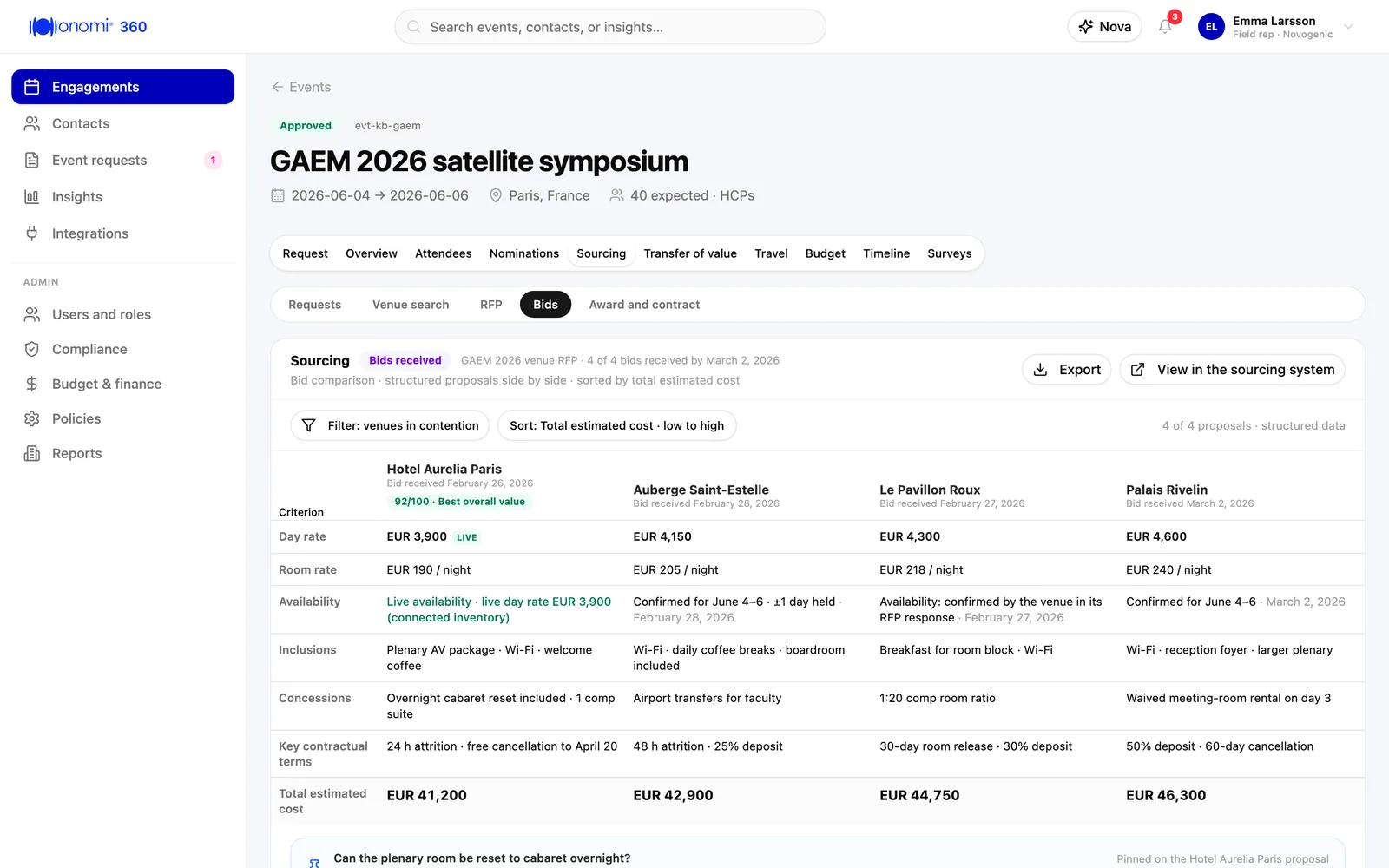
One RFP goes to several venues and responses come back as structured proposals — not PDF quotes — compared side by side on rates, availability, concessions, and contract terms. Awards write back to the event as committed budget, and per-market venue rules act at request, at search, and again at award.
Approvals computed, not hard-coded
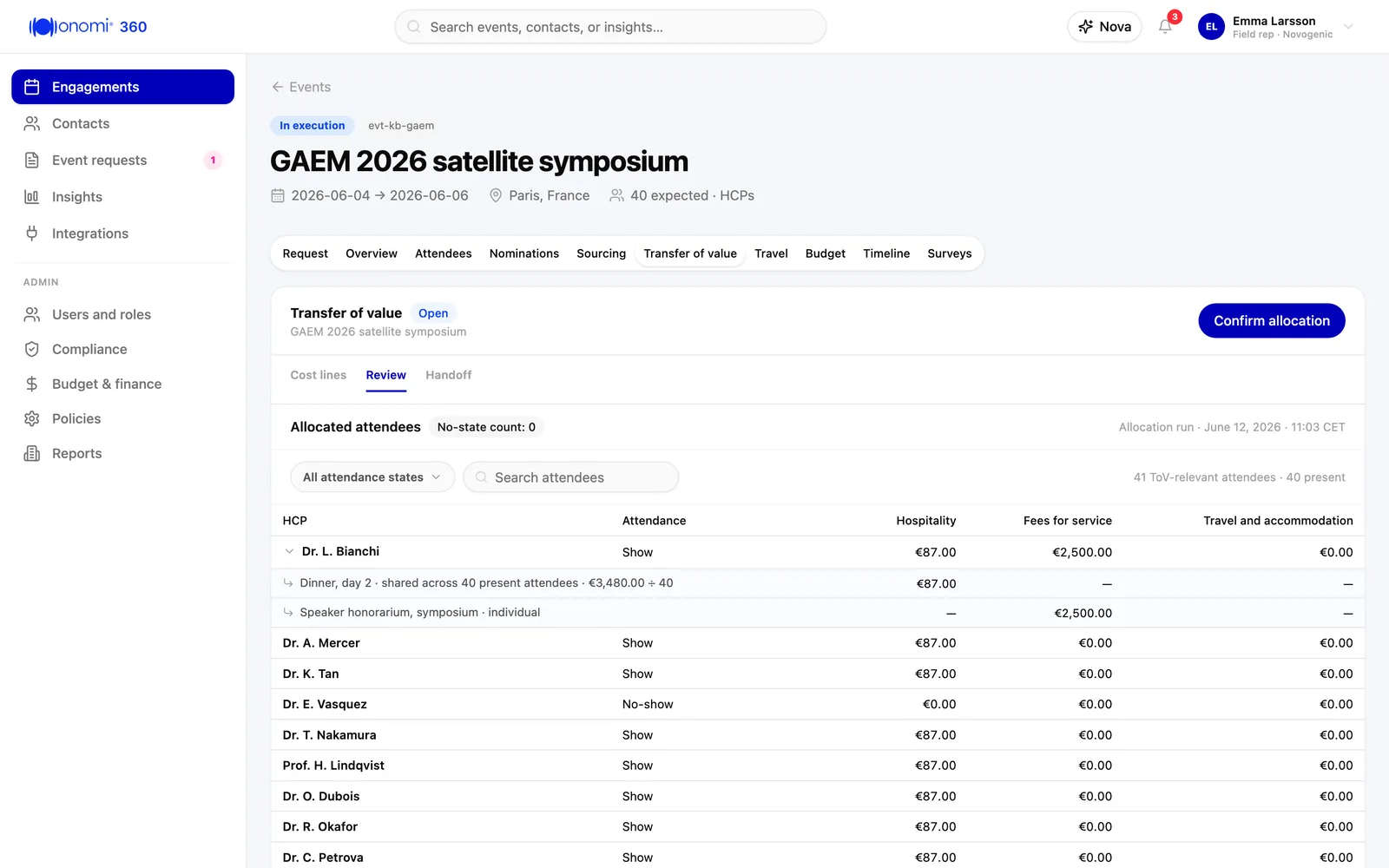
Routing rules combine budget band, attendee type, request category, and meal-cap breaches into ordered approval chains — first match wins, up to five levels. Every request carries a 'why this approver' trace, and a compliance gate adds itself whenever HCP or public-official attendees are present.
Budget that survives to closure
Budgeted, committed, and actual on one record, per line and rolled up by category. A named finance owner clears unmatched invoices against the ERP feed and meal-cap flags with recorded reasons, then closes the event — and the reconciled actuals become the input to transfer-of-value allocation.
Transfer of value from actuals, not re-keying
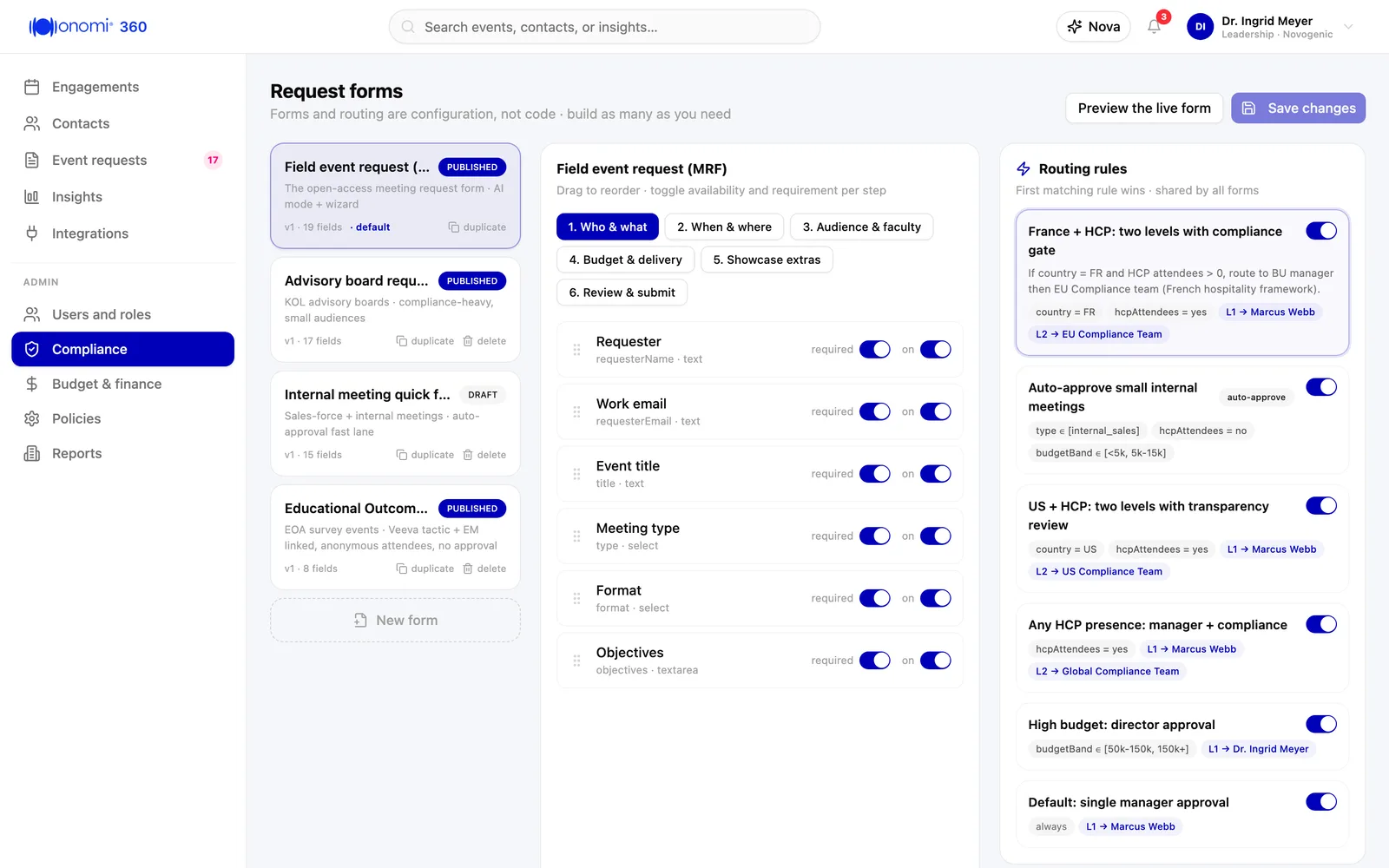
Per-attendee allocation reads the reconciled budget: individual lines attribute to their recipient, shared lines split across attendees recorded present, and anything unattributed is held out and grouped by reason — never silently distributed. Per-country handoffs export as XLSX or CSV, or sync to your transparency stack.
AI with a human at every gate
Describe a meeting in plain language and review the drafted request; get date suggestions with explained trade-offs, approver summaries with risk flags, and attendance forecasts built from your own comparable events. Every output applies only on confirmation and is logged; model calls run with zero data retention.
Most pharma companies license an event platform end to end and use it as a registration form. The gap isn’t missing features — it’s unexercised ones: meeting requests captured two or three steps after the engagement was decided, approvals living in email chains, attendance reconciled manually, and transfer-of-value reporting done in Excel because it beats the module nobody adopted.
Onomi 360 MeetingsEQ doesn’t re-run that consolidation experiment. It runs the lifecycle from request to close on one event record, with five modules — request, budget, sourcing, travel, and transfer of value — and a program layer above them: the org-wide calendar, contacts with per-HCP engagement history, dashboards readable at global, regional, or country level, and twenty standard reports. Configuration is configuration, not code: forms, thresholds, routing rules, and notification recipients are edits your administrators make themselves, never development requests.
Compliance is built into the route, not bolted on after it. Approval chains are computed from budget band, attendee type, request category, and meal caps — first matching rule wins, with a default rule so no request is ever left without a route — and a separate compliance gate adds itself whenever HCP or public-official attendees are present. Every record keeps the trace of which rule routed it and who cleared it. Consent capture is immutable, timestamped, and tied to the wording version presented; attendance is a closed set of states, with signature attestation where a scan isn’t enough.
The boundaries are stated up front, because that’s what makes the architecture trustworthy: the HCP master stays in your CRM or MDM, the ERP and procurement platform stay the systems of record for accounting and purchasing, disclosure filings are generated downstream in your transparency stack, and payments run through your finance systems — Onomi routes, tracks, and hands off cleanly.
The result is the view meetings leadership keeps asking for: one calendar of everything the organization runs, and one answer — per HCP, across every CRM, congress, and format — to “who do we know, and what have we done with them?” The platform ships monthly; AI assistance landed in early 2026 with conversational intake, and attendance forecasting and translation drafting followed within weeks.
Why teams choose Onomi
The loop closes without anyone re-keying
Attendance, engagement, and spend flow back into the CRM and the data lake automatically. Reporting stops being manual reconciliation, and field teams can act while the HCP is still on site — not when a spreadsheet arrives next week.
Sourcing that ends as a budget line, not an email thread
One venue RFP goes out with your organization's terms embedded; bids come back as structured data and line up side by side — day rates, live availability, inclusions, concessions, attrition and deposit terms, total estimated cost. The award writes back to the event as a committed budget line, and per-market venue rules — approved lists, meal caps, centralized selection — police the choice at request, at search, and again at award.
One answer to 'who do we know?'
Registrants, walk-ins, and leads resolve to one master HCP identity across your CRM instances and non-CRM sources. Executive questions that used to take months of spreadsheet assembly get answered from one record.
Coverage that doesn't fragment by system
Intake starts where the engagement is first identified, covers every event type — HCP-facing, internal, cross-org — and lands everything in one org-wide calendar, including events that never touch a CRM.
Approvals your auditors can replay
Who reviews each request is computed from policy — budget band, attendee type, category, meal caps — not hard-coded into a workflow nobody dares touch. The record keeps the trace: which rule routed it, who approved at each level, when the compliance gate cleared. Reconstructing a decision takes a click, not an inbox search.
Transfer of value that shows its arithmetic
The allocation reads budget actuals on the same event record as the attendees: a shared dinner splits across everyone recorded present, an honorarium lands on its speaker, and the unattributed remainder is held out and grouped by reason. Finance gets a per-country consolidated handoff with a synced status per destination — not a spreadsheet rebuilt after every event.
Frequently asked questions
What stays the system of record?
The boundaries are explicit. Onomi never forks the HCP master — your CRM or MDM stays the system of record for HCP identity. Your ERP and procurement platform stay the systems of record for accounting and purchasing. Country disclosure filings are generated downstream in your transparency systems, never in Onomi. And the platform routes and tracks payment claims — your finance stack pays. Seating design and internal resource management sit outside the platform entirely.
Which event types does it cover?
All of them: HCP-facing events, internal meetings, cross-org and cross-border events, congresses, speaker programs, and CRM-triggered virtual events — including events that never touch a CRM. Low-complexity meetings run in a self-service lane; complex programs run the full lifecycle. Both use the same record model and policy engine.
Do occasional requesters need a license?
No. The self-service lane runs on a no-license tier: occasional requesters submit, track, and withdraw their own small meetings through an SSO link, without workspace access. Low-risk requests approve themselves — a qualifying request moves straight to approved when a compliance auto-clearance rule also clears the gate.
How does data get back into our CRM and data lake?
Through composable integration patterns: a Veeva connector running four flows (event intake, two-way registrant sync, engagement write-back, meeting record sync), Salesforce sync, event streaming into middleware, a batch API, and BI/data-platform delivery — for example a Snowflake pattern. Attendance, engagement, and cost land close to real time, with no reconciliation spreadsheets.
What does the AI do — and what will it never do?
Five assistance flows: conversational request creation, date suggestions with explained trade-offs, approver summaries with risk flags, attendance forecasting from your own comparable events, and translation drafting. Every output is presented for review, applied only on a human's confirmation, and logged. Model calls run with zero data retention and your data is never used to train models. Autonomous submission or approval, autonomous event building, and general content generation are explicitly out of scope.
Can agencies work in the platform?
Yes, with containment: agency users get a guest organization role plus a per-workspace working role, so they see only the events they've been added to. Reaching a record and changing it are separate grants, and strategic-meetings roles scope visibility by geography, business unit, and where used, therapeutic area or brand.
Where does venue inventory come from?
Through a connected sourcing partner that, as of August 2026, reports more than 400,000 venue spaces across 124 countries with direct API connections to major hotel groups. Coverage varies by market and real-time availability is not universal — so the module supports instant booking where live rates exist and structured RFPs where they don't. Every award returns to the event record as a committed budget line.
Ask which modules of your event platform are actually live
Bring the answer. We'll walk the lifecycle from request to close on one event record — and show the loop closing into your CRM and data lake, the part the rest of the stack never did.
Book a demo