
Smarter Reps: Using AI to Give Field Teams Context, Not Noise
About the webinar
Pharma teams have spent years building next-best-action engines. The investment is real. So is the problem it created: reps are getting more suggestions than ever, and trusting them less.
The issue isn’t AI. It’s the data feeding it. Thin CRM records produce generic suggestions. Generic suggestions get ignored. And when reps default to instinct, the entire omnichannel model quietly breaks down.
In this on-demand episode, Pierre Metrailler and David Williams break down why the data feeding your next-best-action engine matters more than the engine itself, and what it takes to fix it.
David’s diagnosis: the algorithm isn’t broken. The data feeding it is. CRM records are thin. A rep selects “efficacy” from a dropdown after 2 completely different conversations, one where the HCP was genuinely moved and one where they politely ignored it. The machine sees the same thing. And so the suggestion it generates is the same too, generic, easy to dismiss.
David put it plainly: pharma knows everything outside of the conversation. But nothing inside it.
A blurry input doesn’t get sharper when you run it through a sophisticated engine. It just amplifies the blur. That’s what happens when CRM records are built from category indicators instead of behavioral signals.
The difference between “HCP raised tolerability objection” and “HCP raised tolerability objection and belief visibly shifted” is everything for what you do next. One requires follow-up on tolerability. The other probably doesn’t. Without that signal in the system, the engine guesses.
David’s solution : apply AI to real rep-HCP call recordings. Not to monitor reps, but to surface what actually happened: which clinical questions came up, how the HCP responded, where belief shifted and where it didn’t. Structured, compliant summaries that flow into CRM so the next interaction, whether it’s a different rep, a different channel, or an AI-generated suggestion, starts from the right place.
On consent: 80% of HCPs say yes when it’s framed correctly. The bigger factor is whether field teams feel the tool is there to help them, not to performance-manage them. Get that right first.
Where Onomi fits in
Pierre walked through a problem that’s specific to congresses. A rep visiting a known account can open Veeva, find the record, log the call. At a congress, none of that scaffolding exists. The HCP might not be in your territory. You might not even be their rep. It’s noisy, international, and inherently unstructured.
The result: teams capture, but they don’t follow up. Because there isn’t much to follow up on.
Pierre’s team looked at every point of friction in that process, badge scanning, identity resolution, logging the interaction, and rebuilt the app around removing it. AI matches the badge scan to the right CRM record, returning confidence scores when there’s ambiguity. Instead of checkboxes (the same shallow dropdowns David had just diagnosed as the core problem), reps can record a voice note or, increasingly, the actual conversation. The AI transcribes it, summarizes it, and maps it to the right fields.
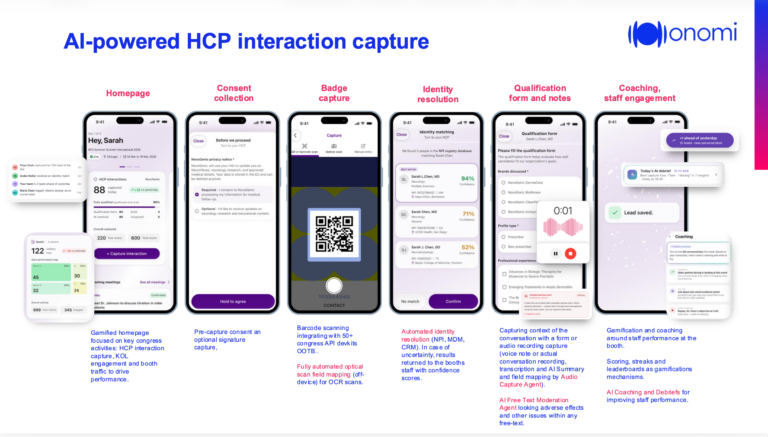
What they heard from reps who resisted wasn’t a privacy concern. It was: “This is beneath me.” The checkbox workflow felt like admin. Recording a real conversation doesn’t. And once the friction is gone, the door opens to everything David described: coaching, behavioral signals, suggestions that actually land.
How to move from suggestion volume to suggestion quality
David laid out 3 things that actually move the needle:
- Compliance buy-in upfront.
Engage legal early, frame the tool as a mirror for reps, not a monitoring layer. The compliance teams who understand what’s being captured typically get behind it.
- Relevance, not volume.
Explain to reps why a suggestion is being made. When the logic is visible (“we heard this, which usually means this, so we think you should do that”), buy-in follows. Fewer suggestions that earn trust beat more suggestions that get skipped.
- A feedback loop.
Thumbs up, thumbs down. Simple. It’s how you improve the engine over time without a major re-architecture.
The starting point for all of it: get behavioral signals from inside the conversation into the system. Everything else builds on that.
Speakers
- David Williams — Founder & CEO, KAI Conversations
- Pierre Metrailler — CEO, Onomi