
From Booth to CRM: The Human + Tech Congress Formula
About the webinar
In this on-demand episode, Paul Bobin (The Other Mind) and Pierre Metrailler (Onomi) unpack a hard truth about congress ROI: it rarely fails because teams lack effort. It fails because the most critical moment of the entire investment, the five-minute booth conversation, is treated as operational detail rather than strategic leverage.
The contradiction is clear. Pharma spends months preparing content, symposia, logistics and internal alignment. Yet preparation for human interaction at the booth is compressed, deprioritized or skipped altogether.
Paul’s perspective was direct. Congress is not a normal selling environment. It is high-pressure, noisy and unnatural. Confidence drops. Behaviors shift. And the most expensive assumption in booth execution is believing that “they are salespeople, they know how to talk.”
Pierre connected this to measurement. Most teams optimize what is easiest to report, not what drives follow-up. Booth traffic, badge scans and a busy stand may look impressive, but they do not equal meaningful engagement. Without structure, visibility and CRM-connected next steps, activity rarely turns into impact.
The conclusion was clear: when human performance and technology are aligned, congress stops being a reporting exercise and starts becoming a measurable driver of engagement.
Paul’s answer was direct. When agendas get tight, internal meetings and clinical updates crowd out human preparation first. Teams say training is important, but they do not fund it or protect time for it like it matters. And there is still a persistent assumption that customer-facing roles do not need support on “how to talk to people.”
Congress, however, is not a normal environment. Confidence drops. Behaviors change. And five-minute conversations carry disproportionate weight. Treating them as routine interactions is one of the most expensive assumptions in congress execution.
Pierre challenged the metrics.
Booth traffic is not the same as HCP conversations. Badge scans are not the same as follow-up. And a busy booth is not proof of meaningful engagement.
When you look closely, a significant share of people on a booth are internal staff, vendors, competitors, or non-target visitors. The number of truly relevant HCP exchanges is often much smaller than the headline figures suggest.
Big numbers are easy to report. They are harder to convert into impact.
The session introduced a more honest model:
Activity → Outcomes → Insights
Pierre walked through a practical operating approach: End each day with a simple, shareable “ report card ” view that makes performance visible while the booth is still live, not weeks later.
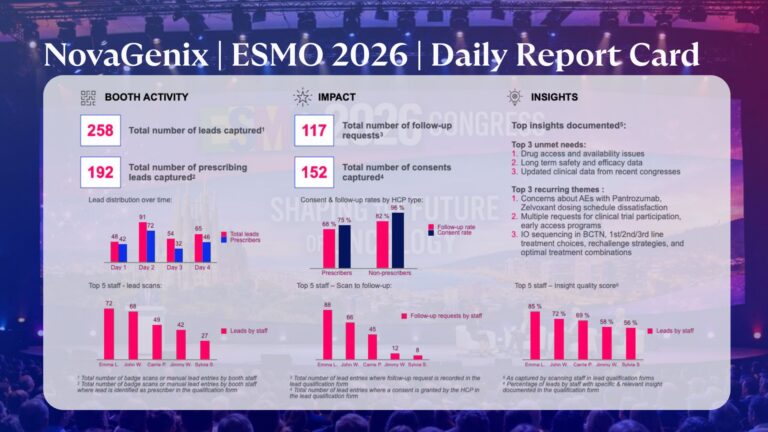
The report card is built around three buckets:
- Activity: what happened (scans, conversations, engagement volume)
- Outcomes: what moved (follow-up requests, consent, next steps created)
- Insights: what was learned (themes, unmet needs, questions that signal intent)
Paul connected this directly to behavior change:
When performance is visible in real time, you can coach in real time.
He shared an example from ESMO: One rep was behind on Day 1. The data made it visible without debate. Coaching happened immediately in a supportive way. Day 2 performance shifted meaningfully. The point was not “more scans.” It was better execution, higher confidence, and stronger outcomes.
First, HCPs expect follow-up. If there is no structured follow-up after a congress interaction, it feels incomplete.
Second, scanning a badge is not the goal. Context is.
In practice, meaningful congress execution looks like this:
- Conversations are captured in real time.
- Interactions sync directly into CRM.
- Next best actions or tasks are generated automatically.
- Follow-up includes context: what was discussed, what was requested, what the HCP engaged with, whether they attended a symposium or accessed specific content.
Embedding follow-up into CRM systems such as Veeva or Salesforce ensures that congress does not live in an Excel file or a PowerPoint summary. It becomes part of the ongoing engagement model.
Kill the Excel. Operationalize the insight.
Paul summarized the operating model for congress teams that consistently outperform:
- Vision and leadership Clear definition of what congress is actually for: not traffic, not noise, but meaningful conversations that lead somewhere.
- Skills and confidence Training that reflects real booth reality: five-minute conversations, pressure, interruptions, and high volume.
- Measurement Activity is easy to count. Outcomes are harder, but they are what matter.
- Coaching Behavior changes during the congress, not in a debrief weeks later.
- Embedding Follow-up should not depend on memory or goodwill. It needs to be baked into process and systems so it becomes inevitable.
- Alignment Global and local teams need the same definition of success and the same follow-through expectations, so booth promises do not die after people fly home.
Human excellence without technology does not scale.
Technology without human excellence does not deliver.
Congress ROI improves only when both work together, and when follow-up becomes part of congress execution, not a post-event hope.
Watch the full session on demand to see how this plays out in practice.
Speakers
- Paul Bobin — Director, The Other Mind
- Pierre Metrailler — CEO, Onomi