How to Turn Congress Data Into Personalized Follow-Up With AI Agents
About the webinar
A year ago, Patrina and Pierre ran a session on turning raw congress data into insights using AI. You’d feed a spreadsheet into ChatGPT, ask for an analysis, and walk away with a dashboard. Useful. But still manual. You were doing all the work in the chat interface and then copying the output somewhere else to act on it.
2026 is a whole new game. Agents don’t just summarize. They do things.
Patrina’s analogy: AI chats have a brain but no arms or legs. Agents have both. And in some cases, eyes too. They can open your Outlook, read your congress spreadsheet, find the right HCP, draft the email, and route it. You simply review and hit send. That’s a very different workflow.
The data behind a good follow-up
Pierre walked through what a full congress engagement picture looks like for a single HCP: booth scan, medical inquiry, symposium attendance, knowledge quiz, question asked live on stage, one-on-one KOL meeting transcript. 7,000 signals across roughly 400 to 500 HCPs in the demo data set.
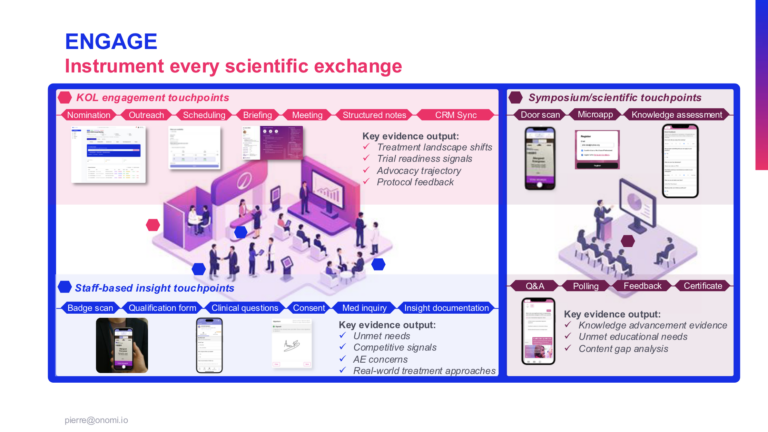
An MSL isn’t going to comb through that manually. And even if they tried, they’d probably miss what matters most.
That’s the gap agents close. Patrina’s MSL Congress Follow-Up Genie pulled that spreadsheet in, identified the personalization signals for a specific HCP (Dr. Carter Richardson in the demo), built a multi-step outreach plan mapped to his awareness and belief levels, and drafted the emails. In minutes.
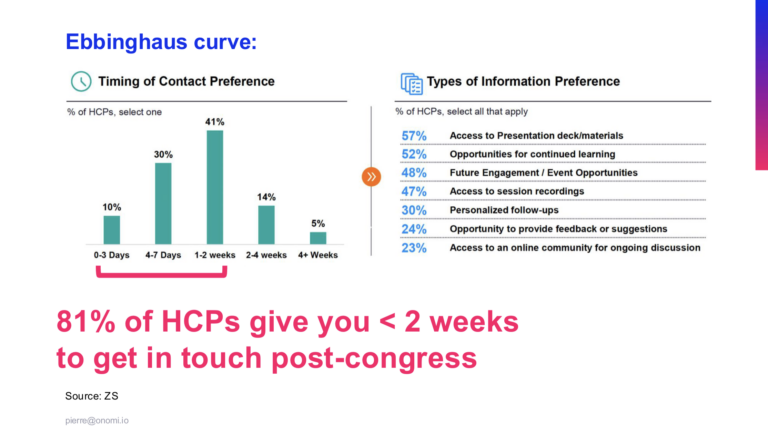
Pierre explained the Ebbinghaus curve. Essentially, HCPs give you roughly 7 days post-congress before the window closes. Not 3 weeks. Not whenever you get back from the next event prep cycle.
What the live demo showed
Patrina built an agent live using Claude inside Copilot Studio. She prompted it to build a follow-up agent, watched it name itself, write its own instructions, and test its own output. Including taking screenshots to check its own work, which is how agents compensate for not having eyes.
The output: a structured follow-up plan with cross-functional collaboration suggestions, a long-term outreach sequence, and drafted emails. Not generic. Tied to what that specific HCP did at the congress.
Pierre then explained how Onomi comes into play: instead of uploading a spreadsheet, the agent connects directly to the Onomi Congress MCP. Real-time access to congress signals, with proper access controls (you see your own HCPs, not your colleagues’) and compliance guardrails built in. If an HCP hasn’t given consent, the agent flags it before an email goes anywhere.
How do you ensure that agent suggestions are aligned with compliance guardrails?
Two layers here. The first is consent. Onomi captures it at the point of interaction, whether that’s a booth scan, a symposium registration, or a KOL meeting. If an HCP hasn’t provided consent, the agent flags it before any outreach is drafted. No consent, no follow-up recommendation. Full stop.
One practical thing to take back to your team
Patrina’s advice before logging off: think about your post-congress workflow as individual steps, then identify which step would actually benefit from an agent. Going too big too fast is where most teams get stuck. Start with: I’m an individual MSL, I need a follow-up plan for one HCP. Build from there.
Speakers
- Patrina Pellett — Co-CEO, MSL Mastery
- Pierre Metrailler — CEO, Onomi